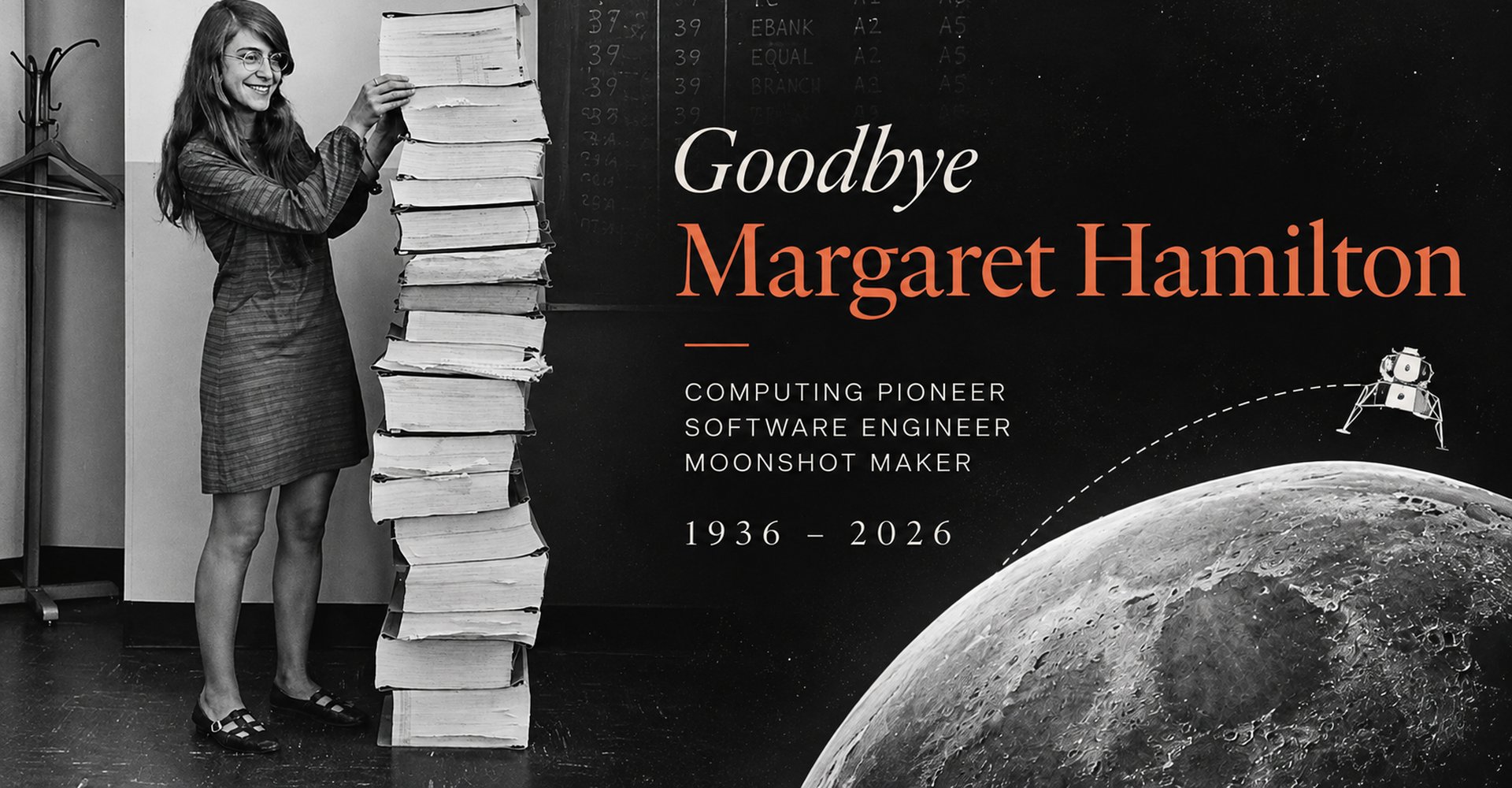
Margaret Hamilton’s name is now part of computing history. But behind that name is a story of ingenuity, persistence and a lot of code.
In 1969, Hamilton led the team responsible for the software running on the Apollo Guidance Computer. During the Apollo 11 lunar landing, the computer began issuing 1201 and 1202 alarms, signalling that it was overloaded. The software was designed to prioritize the most important tasks, allowing the computer to recover and continue guiding the Lunar Module toward the Moon.
Hamilton had joined MIT’s space programme after working on meteorology and the SAGE air-defense system. She eventually became responsible for software development for the Apollo Command Module and Lunar Landing Guidance Computer. At a time when software development had few established methodologies — and the term software engineering didn’t even exist — she coined the term to describe the work her team was doing.
Her approach was remarkably modern: software had to anticipate human error, recover from failures and work reliably when it mattered most. Her famous photograph, standing beside the towering printouts of the Apollo code, has become one of the defining images of the early history of software.
After Apollo, Hamilton continued working on NASA programmes including Skylab and the Space Shuttle, later founding her own software companies. She received the NASA Exceptional Space Act Award in 2003 and the Presidential Medal of Freedom in 2016.
At Cocoon Creations, we spend our days building software. Margaret Hamilton was one of the people who helped establish what that profession could be.
We are saying goodbye to one of the women who helped write the software that took us to the Moon.
We told her story on Breaking the 20% in “Error 1202” in Greek and “Burn, Baby, Burn” in English. Two languages, the same remarkable story.